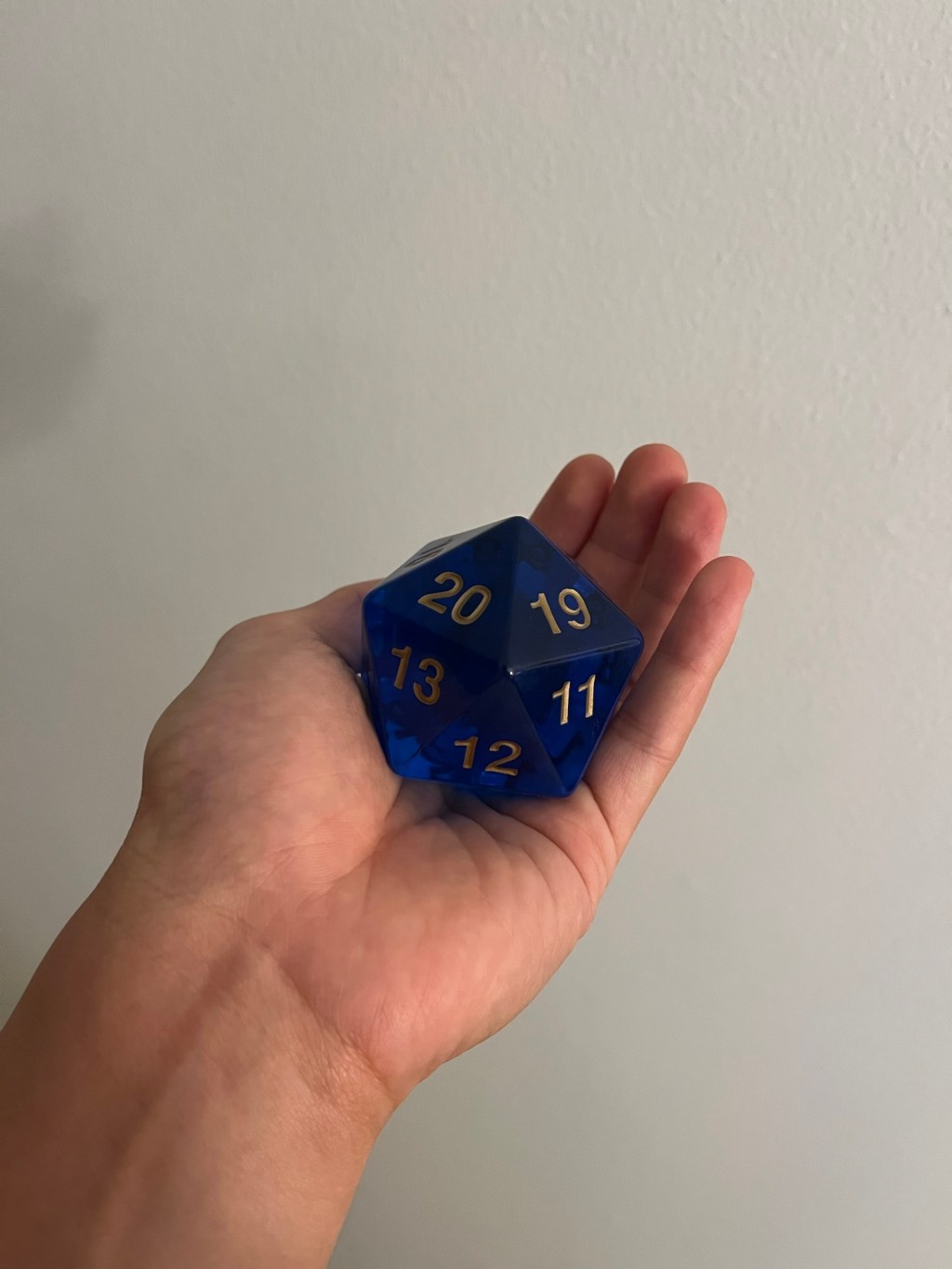
The absolute most important thing for bringing newcomers into TTRPG is setting expectations. The tricky thing is, there is no one-size-fits-all template. Experiences vary wildly from GM to GM – heck, even my own games are extremely different from one to another. So, an individually tailored approach for each group is the best way to go. This sounds like a lot of work, but I assure you it’s simpler than it seems.
Recently, I prepared a mini campaign for some friends who wanted to try DnD for the first time. I thought I’d share my own approach here, as a case study on how to bring new groups to the game as painlessly as possible.
The first step is understanding your group. Here’s what I was working with:
- My party consisted of three people.
- Justin had watched a season of Dimension 20
- Justin and Richard had both played Baldur’s Gate
- Rhonda had actually played DnD, but just one session years ago
- All three players were mostly in it for the story aspect (vs the mechanical aspect)
- All three players were relatively familiar with the concept of roleplay and tabletop
The second step is designing your approach. Let me share a secret with you: a formal “session 0” is rarely necessary – and potentially even deterrent – for a first-ever TTRPG experience. For many new players, a pre-game meeting can feel like homework. With this in mind, I designed a tailored, one-page document to knock everything out in less than 10 minutes.
Let’s break it down section by section!
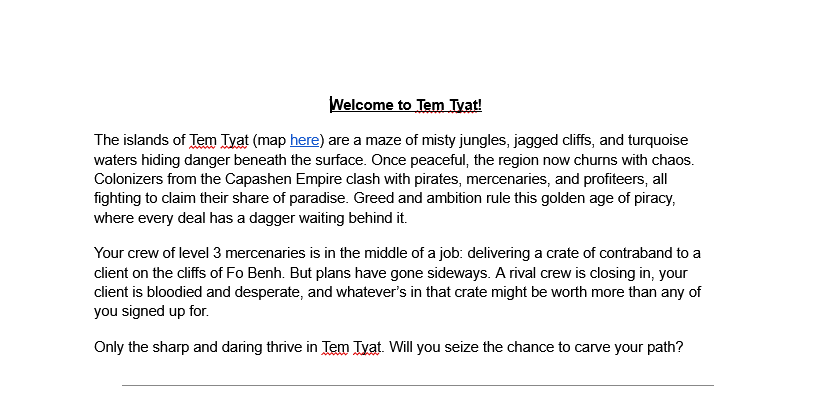
Since my players already had an idea of how TTRPG’s work, I skipped explanations and jumped right into a punchy description of the setting. This story-forward approach is always a strong way to start; it acts like a preview to get your players excited and inspire character/story ideas. “Golden age of piracy” is thrilling and evocative – in just four words, we set an expectation for the adventure to come. Even here, I set expectations about who they’ll be and what they’re doing: they’re level 3, which implies that they’re fairly experienced, and we’re starting right in the middle of a thrilling mission.
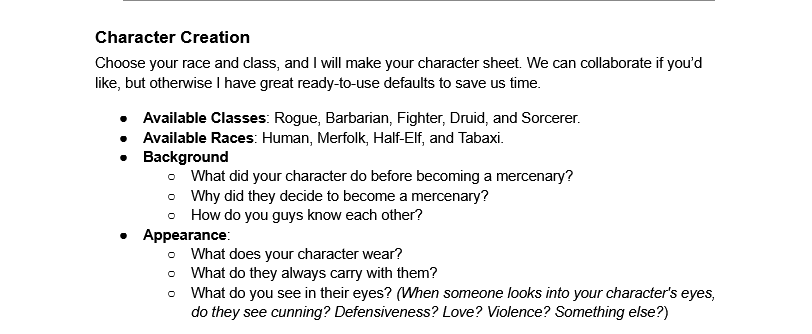
Character creation is the most time-consuming part of bringing in new players. Character sheets can be overwhelming, so I simplify the process by handling mechanics myself. By preparing simple defaults (standard array, simple spells and equipment), we cut 3-4 hours of prep time while still keeping the most critical customization options on the table. To that end, you’ll see that I limited the available races and classes as well, offering only the most beginner-friendly options.
The background questions are designed to maximize output from minimal effort. The first question encourages players to freely describe their character’s backstory, which directs me to choose the most fitting background option from the handbook. The second question is like character motivation in a can – easy for my players to come up with, and easy for me to build around. The last question is about narrative efficiency. For new groups in short campaigns, an established dynamic cuts past awkward in-character introductions so we can get to the good stuff.
Finally, the appearance questions evoke not only a mental image, but also a suggestion of character. Try it yourself: answer these questions; what does it say about you?

One of the most intimidating things about starting TTRPG is the sheer amount of time it takes. No matter how long you’re playing, set an expectation and stick to it. I can’t tell you how many miserable games I’ve played where the GM carelessly extended an hour or longer past the agreed-upon end time. The last thing you want is for new players to feel trapped or bored. For newcomers I suggest 2-3 hours – ideal for maintaining attention spans with flexibility to cut/extend depending on the vibe.
Building on this, I like to share a projected estimate on how long the campaign itself will be. Players are much more likely to join a game if they know it’s temporary. I know many players who unwittingly joined long-term campaigns and didn’t know how to “escape” for fear of being rude.
I also included a quick note on technology – this saves the trouble of people telling me at the start of session that they don’t have zoom or a webcam. If there’s any issues, it’s dealt with long before game day.

Finally, one of the most important parts if not THE most important part of the session 0 is leaving the door open for safety discussions. I’ll be the first to admit – this can sometimes feel like wasted space, especially since I’ve (luckily) never had an issue with sensitive material or safety in my games. However, I’d rather include this every time than make anyone feel unsafe at my table even once. I keep it brief and weighty, along with some of my own boundaries.
What about the rules?
Here’s my hot take – before session, you shouldn’t explain the rules. We all know how to play pretend. TTRPG’s just add structure. I love teaching rules through play because, when done well, they become part of the story’s rhythm. A player’s first spell, their first dramatic saving throw – those moments are more exciting when they unfold naturally rather than through a rules lecture1. Of course, this necessitates an impeccable understanding of the rules on the GM’s part – as well as a deep familiarity with each player’s character sheets and the ability to direct players through their contents seamlessly. Easier said than done, but it comes naturally with practice and is, I believe, the best way to bring players into the game.
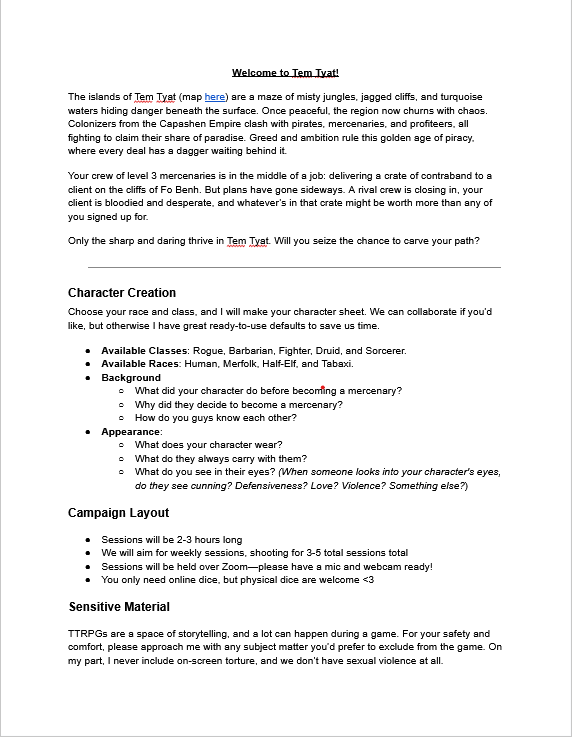
Here’s the whole thing, all together
~~~
And just like that, we have a comprehensive introduction to the game! We keep interest high, save tons of time, and leave elbow room for players to ask questions. This document was tailored for my group, but the principles can be adapted for any table – add and subtract as needed. TTRPG is one of the most beautiful expressions of storytelling and creativity. The more people that experience that, the better. With a little care, we can give new players their first taste of what makes this game so special. The first roll. The first risky decision. The first time they realize anything is possible. Once they see that? They’re hooked.
So, what do you include in your session 0’s? Do you have them at all? What was your first TTRPG experience like? Who taught you how to play the game, or did you have to teach yourself after several bad runs? Let me know in the comments and I’ll see you next time. Thanks for reading!
- Check out this video in which Deborah Ann Woll teaches Jon Bernthal how to play in like 30 seconds flat. This is how it could be ↩︎
 Center of Gravity
Leave a comment