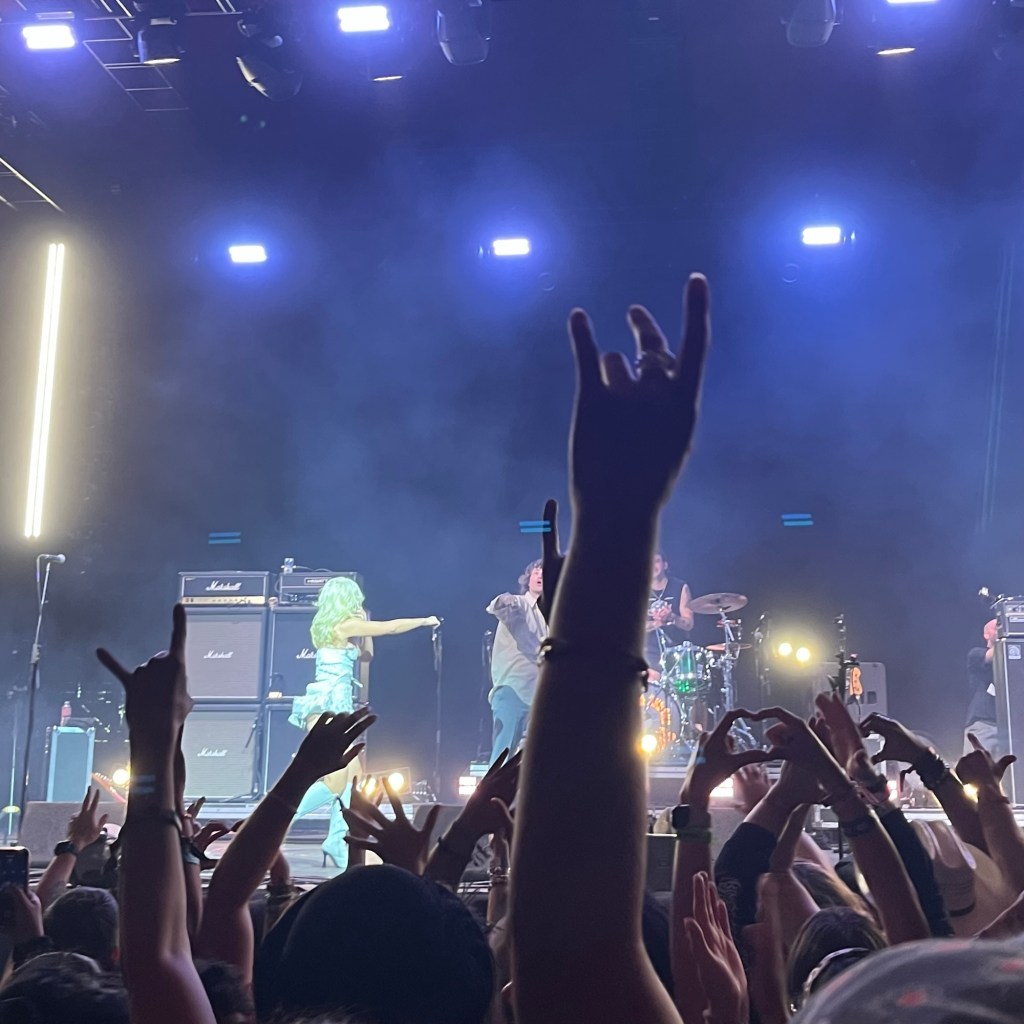
Admission was $5. The place smells like stale sweat and chemical cleaner. It’s small, capacity no more than a couple hundred, and the walls are thick and soundproofed. The house lights fade and there’s a cheer, followed by electric silence.
We live in a world where everyone is constantly watching. Every situation is a combination of expectations and parameters; you only get what you want if you play ball. Cameras are always on, and even though “cringe” is trending , true authenticity isn’t always received well. Honestly? That’s okay. We soften truths and sanitize ideas because if everything were harsh and raw, it would all fall apart. If we were our genuine selves in the workplace, with our families, even with some of our friends? We’d endanger it all. We hold our lives in that delicate balance: Show just enough to feel real, hold just enough to feel clean. You know you’re doing it right if it hurts.
It begins with reverb, a whining dissonance that saturates the humid air with suspense. Everywhere, bodies: shifting in excitement, preparing for the coming ritual. Then, the mic crackles. The floodlights come on with a slam. A guttural war cry shakes the room, and the mass of bodies separates like a crashing wave. A circle—a yawning portal—opens up, and people begin to churn around its perimeter. The first verse picks up speed, and so does the crowd. It’s a whirlpool now, lurching, churning, building…
Personally, I like that society demands control; it suits me well. But in a world that demands uniformity, a space to let go isn’t just nice—it’s needed. That’s why I find myself at live shows, looking for surrender in music and crowds. I seek the cathartic: techno, bass, trance, rock & roll—genres that encourage freedom of expression. Each suits a purpose, but there are limits: I’ve realized that each of those genres, in their own way, has internal controls; chaos in form of neat little prescriptions. Too many times, I’d catch judgmental looks at shows for dancing too hard or shout-singing too earnestly. It’s embarrassing, shameful, and worst of all, annoying. I thought I’d never find the true catharsis I was looking for. That’s when I found hardcore. That’s when I found the pit.
The chorus drops and the room detonates. Those first dissonant chords are a call to blood. The crowd starts swinging: arms, hands, elbows, boots. You roar in response, animal, raw, as you throw yourself into the chaos and let it take you. You’re shoved recklessly, endless kicks connecting with your legs, your side, your back. Then—blink and you’ll miss it—a fist explodes against your head. The world goes white. Your ears ring as the room turns and you realize you’re slumped into a wall of arms, holding you up like strings on a puppet. You grin, surging back into the fray with your own flurry of blows, each a gift with no recipient. Holy violence. Sacred release.
Violence in the pit is an exercise in affirmation; pain as means to feel the wholeness of your soul. It’s not numbing, but rather elevated, phantasmal. In our daily lives, we protect our bodies with precious fragility, but in the pit, we realize just how resilient we are. Getting punched in the face doesn’t hurt as much as you’d think. It’s all about expectation: outside, a punch is a humiliation, a failure; inside, it’s a beat on the drum, a redirection of movement. Real pain, the kind we carry with us every day, is mostly internal: Rejection, insecurity, anxiety. Those are the real knives. In the pit, we find strength and clarity, reclaiming our bodies with every kick, shove, and punch.
As the pit churns, the perimeter forms a makeshift net to catch, stretch, and launch the bodies back into the chaos. This threshold is a protective barricade, a place of respect and safety. The wall of forearms prevents the violence from spilling outside, catching stray hits, saying, “here, and no further”. Suddenly, a ripple of alert rolls through the crowd as dozens of phone lights come on, illuminating the floor: a body laid out, hands rushing to help them up. They’re hoisted onto their feet, and they raise both fists high in the air, triumphant. The crowd roars, the show goes on.
The pit runs on an intricate social contract. It’s all about release vs violence, aggression vs malice; an incredibly fine line that participants walk carefully, if not perfectly. Granted, there’s no accounting for mistakes or bad actors: a shove in the wrong direction or crowd kill taken too far can ruin a moment. There is, however, a majority sentiment of protection and correction, a vigilance in the pit that I haven’t seen anywhere else. There’s a surprising safety to it; nobody is there to hit; people are there to get hit—there’s a big difference. To that end, I was surprised to find that hardcore spaces are incredibly (and at times totally, as an enforced rule) sober. This comes from the mutual understanding that to be in the pit is to be altered; it’s a drug in its own right. You just need to be willing to feel it.
The song crashes to a finish, and in the heaving, gasping, sweaty pause, the band thanks the crowd for coming. The set is almost over. You look around and you’re surrounded by strangers—not one familiar face—yet you’re bonded to each and every one of them through gauntlet of the pit. The guy that sang with you when neither of you knew the words, the girl who handed you a ripped t-shirt for your bloody nose, the person in the penguin onesie that decked you then helped you back up. Color, gender, background, none of it matters—you’re all here for the same thing. You’re here to let go. The band announces their last song, and the pit opens one last time.
For me, life is a series of stages. Sure, it’s fun to perform, but it’s also exhausting. If I’m not careful, I forget who’s wearing the mask. Once, a friend accused me of being “hyper-masculine” for enjoying the hardcore scene. That stung, because the truth is, the pit isn’t where I go to be a man or act tough. Life demands enough of that from me already. Sometimes, after a long day, I feel a soreness in my soul—the weight of performing masculinity, professionalism, acceptance, or whatever other bullshit society demands. But in the pit? Nobody pretends. When I’m in the crowd, I don’t feel any one identity more strongly than any other; in fact, I don’t feel identity at all. And that? That’s bliss. To be untethered from ego, judgment, or expectation—I haven’t found that anywhere else. I hold it like a treasure, but I offer it freely, breathlessly, to anyone willing to listen. The pit welcomes everyone.
As beautiful as it is, chaotic release can’t be regular or planned. When the concert ends, I return to the real world healed. I get loud so I can hear silence. I get dirty so I can clean up. And after, the world is a kinder place. That’s why I still find catharsis in safer spaces—in writing, in running, in horror. Life is more beautiful when you live in the contrast: when you follow the rules but allow yourself to live freely when it matters most.
And then, inevitably, after the silence: the moments when I’m sick and tired of editing. When I’m boxed in, bone-tired, and overly sanitized. In those moments, the pit calls again—a way forward. A way up.
EVERYONE GET THE FUCK UP ON THIS STAGE!!!!!
The stage looms above you. It’s at least seven feet tall, but you surge onto it, carried by the tide of bodies. You’d think it would feel braver than this, you think you’d have more to say, but no—it’s just color, light, sound. You won’t remember how it happened, not exactly, but your body will hold the shape of this moment. Your soul will feel the echo for days to come. You stomp to the precipice and call your shot, the wave of hands reach up, you run, you leap, you soar.
You fucking soar.
 Center of Gravity
Leave a comment