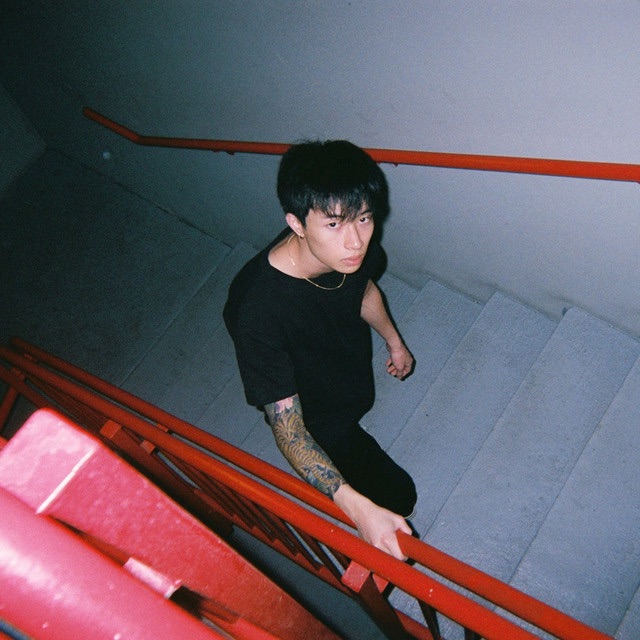
Who is Keshi?
Casey Thai Luong, aka Keshi, is a Texas-born Vietnamese singer who, over the past few years, has soared into the mainstream. The best way to describe his music is safe: an inoffensive blend of bedroom/lo-fi/hip-hop/R&B over a four- on-the-floor beat. Sometimes, there’s a bit of synth or swing to spice things up, a guitar solo to signal a pulse, however faint. He sings about love and loss—but never with any kind of nuance. Everything he writes feels algorithmically caption-ready, perfect for an Instagram story over a sunset shot. He’s a talented-enough musician and his voice is marketable, sexy, and ranged. He’s okay live. He makes great background music.
Who is Keshi for?
I remember UCR with a bitter fondness. Everybody was listening to Keshi—the familiarity in his sound was the shared fabric in that incestuous social web of frats and student orgs. He was everywhere. People adored him. Despite that, I felt a sense of disdain. A kind of repulsion at the banality of what people swore was the peak of music. Sure, I’d play a song or two when driving friends around, but in private? I thought I was above it. Who is Keshi for? Apparently, everyone but me.
The contrarian in me loved how easy it was to hate him. And it’s still easy. Just listen:
[Chorus]
Baby, I call in the dead of night
But you don’t need me like I need you
Pray that I won’t be alone
Baby, I call in the dead of night
But you don’t need me like I need you
Pray that I won’t be alone
[Verse]
Layin’ on the bed waitin’ for your text (Be alone)
Babe, there’s nothin’ left
Faded, I’m a wreck (Be alone)
Afraid what’s comin’ next
Wished we never met (Be alone)
Layin’ us to rest but baby, I beg you (Be alone)
Too soon with a drunk call
In the middle of the night
You took it, my fault
Didn’t really mean to interrupt, yeah
But if you change your mind, then hit me up, no
Yeah-eah
It’s the kind of bald-faced honesty that dares you to laugh. Lying in bed thinking, staying up waiting for a love that might never show up—the ideas are so simple that describing them is a stone’s throw from rewriting them. And yet, it’s vague as hell. He’s sad, but why exactly? The answer is: It doesn’t matter. Every word is aggressively blended and filtered to fit the vibe of the backtrack, annunciation be damned. You catch a “wish we never met” or a “drunk call”, and everything else? Emotional decoration. The lyrics aren’t meant to be read. They’re meant to be absorbed—like moodboards in lowercase.
The real magic is in the production. Like most lo-fi of the time, the song opens with a muffled, ambient hiss—you can hear crickets in the background, maybe the sound of a car passing. Keshi adjusts his acoustic guitar then strum—a falsetto rings out like a bell, soft and sad. Then comes the drop: a low-filter kick, saturated hi-hats, and a simmering snare roll. It’s slow. Beautiful. Completely unoriginal. It’s R&B heuristic through and through, but that’s why it works. It says: This is sad, but it’s a vibey sad. He’s crying but damn if he doesn’t look good doing it.
I could go on and on, but I’d be wasting my breath. Keshi’s music was never meant to be dissected. It was meant to be lived. And at UCR, people did exactly that. You’d hear it leaking out of car windows, thudding softly through apartment walls, playing from tinny Bluetooth speakers at 3am smoke circles. What I called bloated pastiche was, for everyone else, gospel. And maybe that was the problem. The music was everywhere—and I felt like I was nowhere in it.
UCR
Let me tell you something about UCR. We were also known as UC Ratchets and UC Rejects; a campus that skewed wild, messy, and unfiltered. That reputation put us in a tense emotional position—our pride was held constantly in reference to our shame. Nobody wielded this better than the social ruling class: The East Asians. They were at the top—frat boys with middle parts and designer slides, ABGs in crop tops and lashes thick enough to cast shadows. They were beautiful, dangerous, and emotionally fluent in the exact ways that got them what they wanted.
What made them powerful was the mix. The scrappy energy of campus gave them cool points for “punching up”, but they still moved through the world with the access and safety of Asian privilege. That tension—rawness plus polish, outsider plus favored minority—was electric. And they knew it.
Keshi was their soundtrack. His soft, “street” aesthetic fit them perfectly. Half trap, half Tumblr-core, his music had just enough sub-bass to rattle the trunk of a lowered Civic in the 7 Leaves parking lot. And yeah, it was street, but not really. It was SoundCloud-street. A version of LA grit softened through reverb and ring lights. Anyone in the trenches for real could spot them from a mile away, but at UCR? They could throw on some Jordans, bump some Keshi, and pretend.
Meanwhile, I was Filipino. Asian, but not the kind that counted: Too dark, too loud, too off-beat. I orbited their parties and friend groups, close enough to feel the warmth but never invited into the center. And every time Keshi came on, it felt like a reminder: this sadness isn’t yours. This beauty isn’t for you.
So who was Keshi for? I just had to look around. He was for them—the east asian cool kids, the fuckboys and softboys, the predatory lovers baiting women with the promise of vulnerability. He was for the girls that should’ve known better, the ones that would get with the same guy over and over because this this time it’s different (it never was). Keshi was for the vapid, the fake, the stupid. For people with bad taste and worse judgment.
I wasn’t just bothered by Keshi. I fucking hated him.
I hated people that listened to him.
But most of all?
I hated how much I wanted to be one of them.
Keshi’s music came from that aspirational world that I was never allowed into. From the outside, everyone was so pretty. They were porcelain—ideal, adorned in streetwear. Me? I was brown, queer, dressed in shame. Their sadness shimmered, soft-edged and photogenic. Mine was just shriveled and pissed off. What I wanted most was to live the stories they got to tell. I wanted to break hearts at parties and sleep with strangers. I wanted to make a mess and call it art. Then I wanted to lose it all—drenched in alcohol, sorrow splitting me in two while Keshi sang my story into legend.
Instead, I spent years watching. Loathing. Performing disdain while secretly aching to belong. I curated a version of myself that would never be mistaken for one of them, then wondered why no one gave me a second look. I clung to moral superiority like it was a personality trait, bitterness like a shield. And when I finally found someone who loved me? I stayed with her—not out of devotion, but inertia. Because I was too scared to be alone, too unsure of who I was without someone there to believe in me. I didn’t leave. I didn’t cheat. I just decayed in place. Not a fuckboy, not a heartbreaker, not even a good man. Just a coward with a clean record.
Once, she asked me if I listened to Keshi. I said I’d never heard of him.
After
After college, I didn’t listen to Keshi for a long time. I got sober. I stayed single. I started living like someone who wanted a future. I’ve never thought healing meant fixing what’s broken; I think it’s about naming things—and moving on. In that sense, I hadn’t healed at all. I just forgot. The world of UCR faded into the background until it stopped echoing altogether. And then, years later, there it was again: Keshi’s name, printed on the Coachella lineup like a dare.
I opened his Spotify profile, more curious than anything. He’d dropped two albums since I’d stopped listening, and to my surprise, I felt proud. I wasn’t sure why. I was just glad he hadn’t stopped singing. As I hovered over the old tracks, I expected to feel something—bitterness, resentment, maybe even shame. But honestly? I didn’t feel anything at all. I took a deep breath and hit play.
In the weeks leading up to Coachella, I had Keshi on repeat. He followed me everywhere: the gym, work, late-night writing sessions. I wasn’t trying to solve a puzzle or absolve the past. I just wanted to remember. Listening to him felt displacing. I’d call it a phantom pain, but that’s not quite right—it didn’t hurt. It was the shape of sadness but with no weight. Like waking up from a nightmare and realizing it was never scary to begin with. In that way, his music was comforting.
I thought about UCR. Sure, I never explored what could have been. Sure, I wasn’t honest about what I wanted. But all of that was tangled in a hierarchy that only ever existed in my head. Back then we all cared about the wrong things. Whether I was one thing or another didn’t matter, because now? It’s all gone. I’m not sad I wasn’t a “fuckboy”. I’m not sad I didn’t get to live that life. I know that now. But what I do mourn is how simple it was. I like my life better now, but it’s anything but simple.
A Second Look
I’ve listened to a lot of Keshi in the past few months, and here’s what I can say now: Many things can be true. Keshi’s music is unoriginal—but accessible. Keshi’s lyrics are plain—but real. Vulnerability doesn’t need to be innovative to be valid. Art doesn’t need to be complex to mean something. Keshi is deep like a bruise: surface-level, sure, but tender. Purple. Visible.
As simple as he is, he did something important. He put Asian men in the center of an emotional narrative. He allowed us to hurt. Looking back, it’s obvious why I was skeptical—it was hard to trust a softness I’d never allowed myself to feel.
Who is Keshi for? Maybe he isn’t for anyone, really. An audience’s response is not the artist’s responsibility. Whether we weaponize his music, romanticize it, or condemn it—it says more about us than him. I used to think I was different from the people who listened to him in earnest, but the truth is, we were all hearing the same songs. I just missed my chance to sing along.
That’s something I only understand now, years later, enjoying his music as I drive through my hometown, wanting to cry but not being able to. I don’t regret much, but I do wish I’d been more honest with myself back then. I wish I hadn’t hated Keshi when I needed him most. I wish I’d tried harder to see that, pretty or not, sadness sucked the same for everyone.
But it’s too late to change that.
I’m not sad anymore.
I’m just here.
Listening.
Cocahella 2025 | Outdoor Theatre, Keshi’s Set
I was at the rail. There he was, like a dream, just out of arms reach. Just like always. He was singing his heart out—Soft Spot swelling through the speakers as the sun melted behind the mountains. I wasn’t sure how I ended up there, but I think it’s exactly where I needed to be. When my friends asked why I wanted to see Keshi, I didn’t have an honest answer for them. I still don’t.
Next to me, a guy was ugly-crying, shouting out every lyric like he needed it to survive. Between songs, I rested a hand on his shoulder and asked if he was okay. He pulled me into a wet, snotty hug. Two girls to my left were screeching, phones out, too drunk to realize they hadn’t hit record. Behind me, I heard someone mutter, “Who is this? I think its Kashi. Yeah, he’s alright”.
I looked up, squinting into the sun—not really searching. Just… seeing if there was anything I’d missed.
I smiled. I shrugged. And then I walked away.
I had other sets to get to.
 Center of Gravity
Leave a comment