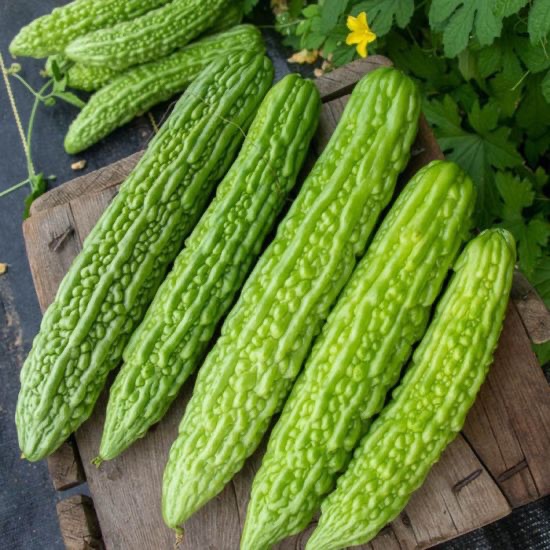
My favorite Filipino recipe is pinakbet. Making it is simple; you could do it in an hour. First, the umami base: pork belly, onion, garlic, tomato, and bagoong. The smell is enchanting. Next, you add water and a bunch of vegetables. Wait a while, season to taste, and boom. Pinakbet! On paper this would be perfect, but there’s a catch. See, pinakbet has an ingredient known as ampalaya—also known as bittermelon—and it tastes exactly how it sounds. Fucking bitter.
This isn’t a quality you can remove. Trust me, I’ve tried. You can soak it. You can salt it. You can scrape the pith til its paper thin. No matter what, the flavor permeates the stew with prejudice.
Even more, ampalaya is just plain ugly. Its awkward, asymmetrical body is a swampy shade of green that evokes a sense of perpetual un-ripeness. Its skin looks wrinkly but it’s actually turgid (somehow worse!) and scattered with wart-like bulbs that feel about as pleasant as they look. When you cut it open, the seeds are embedded in a soft, milky flesh that you have to scoop out with a spoon. It looks like it might kill you.
It’s not like you can hide its ugliness; the dish itself isn’t pretty either. Pinakbet roughly translates to “shriveled vegetable” which is tragically apt. As it cooks, the colors dull, and the vegetables lose their shape. To make matters worse, the okra bursts, the mucous-like flesh making the whole pot a slippery mess. Even if you ignore the visuals, even if you trust the process, even if you believe surely this will be greater than the sum of its parts, you remember it’s all an elaborate sabotage. The ampalaya’s in the mix—it’ll taste at least a little bit bad.
When I was a kid, my lola would make pinakbet for my diabetic lolo when I visited for the summer. He needed the charantin, a chemical found only in ampalaya that lowers blood sugar. Whenever she cooked, I was there, nose over the counter, watching. Every time, I would get the same brows-furrowed look of disapproval, Boys don’t cook, balong. Her disdain only bolstered my curiosity. Plus, I knew the truth—she wasn’t just cooking. She was casting spells. Bitter potions filled with bitter magic.
My sisters balked at the flavor, but to me, it tasted like power. I imagined if I ate enough, I’d live forever. I still kind of believe this. It didn’t help that lola guarded it like some kind of terrible family secret. She’d whisper to me the power of the ampalaya, but when I told her I wanted to make pinakbet myself at home, she’d look at me with real fear in her eyes. Don’t tell your friends, balong. They won’t understand. Jokes on her. That was part of the appeal.
Filipino cuisine is widely seen as a shiny, greasy, monoculture. Whole-roasted lechon, chalices brimming with halo-halo, fried chicken smothered in gravy—these are the foods that grace tiktok with bombast and spectacle. It screams; we don’t have much to offer but look! We’re the most exotic gluttons! The Filipino food I grew up with told a very different story. Sure, we put hot dogs in spaghetti, but we also have steamed fish, ginisang, and of course, pinakbet. I’ve been asked one too many times if I’m skinny because I “don’t eat Filipino food”, a question that has long perplexed me. You’re telling me an entire country’s cuisine is unhealthy? Bullshit. We hold indulgence in one hand and survival in the other. Both are needed, both are good. Also, I eat Filipino at least twice a week thank you very much.
Pinakbet, to me, represents the back half. The stuff that makes my culture real. Of course, I’m proud to be known for the flashy instagram-ready food, but I want to be known for the real stuff too—even if it’s “gross”. Sometimes I wonder why my lola didn’t feel the same way, why she wanted to keep our food a secret at all costs. I think, maybe, she didn’t want to be seen the way I do.
Decades ago, when she moved to America, she left a lot behind. She learned English, found a church community, raised an American family—all the right steps. A clean break still hurts, though. I always had a sense that she was missing something. There was a delicacy in the way she moved through the world, like someone was always trying to take something from her. I never understood that. Eventually, she moved back to the Philippines. She’ll probably stay there for the rest of her life. I still think about those days when I’d watch her in the kitchen. I wish she’d have let me in, but if excluding me meant protecting the one place she felt safe, I’ll forgive it. Maybe she saw my eagerness as irreverence, my excitement as exposure. Maybe, for her, the bitterness was something to hold, close and quiet. I guess we can agree to disagree.
We’re not particularly close, but I’ve always felt there was something unspoken between us. You could call it a mutual respect or suspicion; both are probably true. She was actually supposed to visit this summer, but for health reasons, she canceled the trip. If I’m being honest, I was relieved. She’s very particular. But I do wish she could’ve tried my pinakbet, if only to show her that, whether she likes it or not, I’m keeping it alive. Not to be mean or anything, but just so she knew. That would’ve meant a lot to me. I think it would’ve meant a lot to her too.
Here’s the thing. I don’t like the bitter taste of ampalaya any more than the average person—but do I like the way it feels. It’s bold and self-referential; it doesn’t let you forget it’s there. I relate.
Is this piece a call to action for everyone to try pinakbet? Absolutely not. I’m not gatekeeping it either, though. I just want people to know it’s there, that I love it, that it’s a part of who I am.
Sometimes when I make pinakbet I consider omitting the ampalaya, even just once, for a smoother flavor. But then, I remember my first time making it. It was a mess—the pork didn’t render right, I overcooked the eggplant, and I learned the hard way not to use sliced okra. But the one thing I got right? The ampalaya. Because of it, it tasted just enough like pinakbet to try again, and again, and again. It was the nasty, lumpy lodestar I needed to find my way home. I don’t remove the amapalaya because, without it, it wouldn’t be pinkabet. Plain and simple. Funny thing is, that’s the one thing lola would agree with me on. For us, the bitterness stays.
 Center of Gravity
Leave a comment