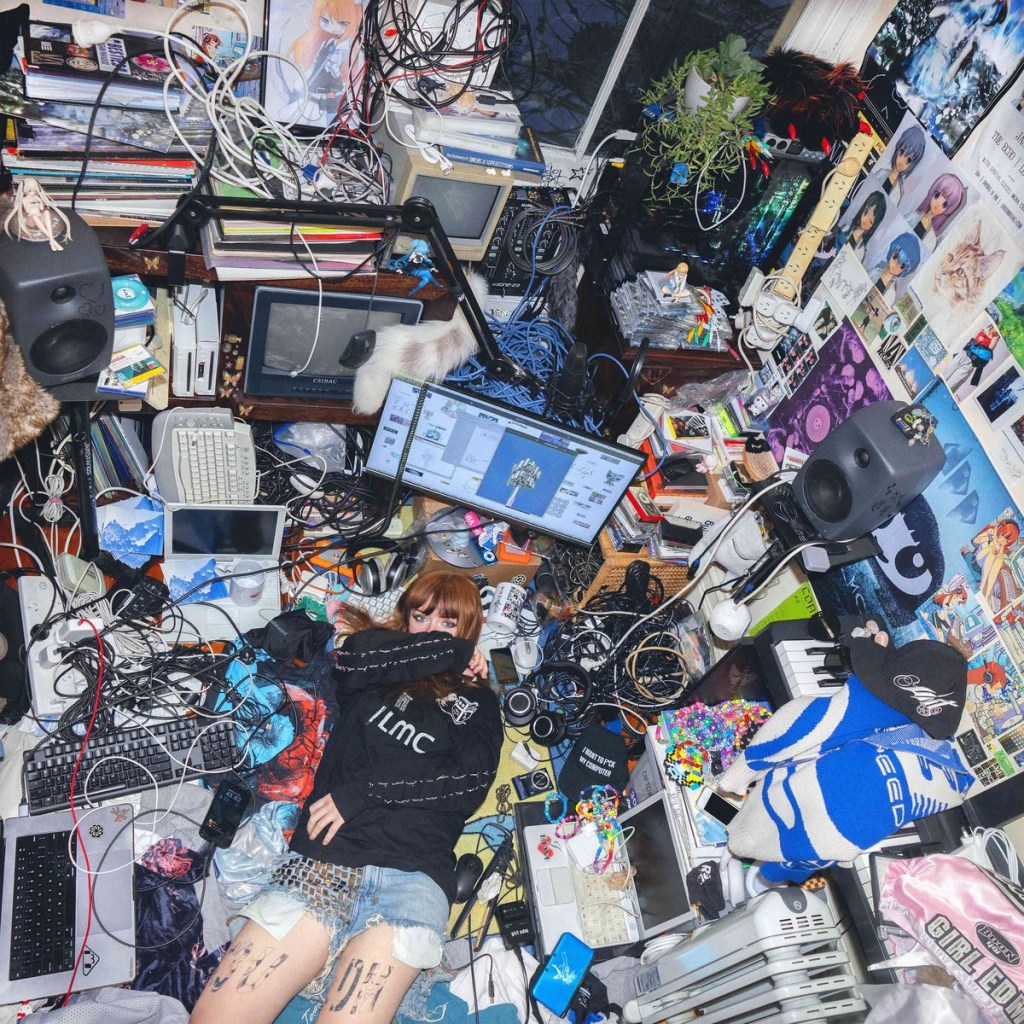
The song gasps awake, forcing itself alive like a resuscitated heart. The beat growls heavily over scratchy kicks that wobble at first, eventually finding a decisive, syncopated rhythm. The melody builds in layers, a cacophony of digital sound bytes coming to a crescendo when, suddenly, it pulls back. Then, it explodes. Synthesized vocals slice through like a knife: Anything is possible with fingers, eyes, a mouse, and a screen. This is the call to worship, the precarious ethos upon which Ninajirachi’s debut album I Love My Computer balances, tips, and eventually plummets from in spectacular, digital flames.
Even at 25, Ninajirachi has years of experience producing electronic music, a result of a childhood spent online. A quick look at her Spotify shows a long list of remixes, collections, and EPs dating back to 2017. Among these, I Love My Computer stands out as her most ambitious, polished, and personal project by far. It’s a story, but not in the traditional sense: each song is an exploration of an angle, a feeling, a claustrophobic niche that defined the experience of growing up with the internet. Normally, talking about modern tech is a tired exercise. We all know how great/awful it is; that horse has been dead for a while. Ninajirachi cuts the crap by zooming in on her own story. I Love My Computer is like a late-night post-rave confessional where everything comes tumbling out. You’re not sure you’ll remember everything when you wake up—hell, you barely understand it in the moment—but somehow, you know it’s important. Somehow, you know it’s real.
The album is loosely split into three acts. The first act is all about momentum: London Song (mentioned at the start) hits the ground at a dead sprint. This jolt gives way for iPod Touch, a smoother track steeped in neon nostalgia. It’s easy to see why this one is a crowd favorite with its euphoric melody and addictive, chant-worthy chorus. At this point it’s clear that her sound is strongly influenced by 2010’s EDM, taking heartily from the likes of Skrillex and Porter, though, notably, she infuses unique and modern elements to keep things fresh.
Despite her bold sound, her delivery is consistently balanced; she embodies the internet at its messiest in such a way that’s appreciable, not overwhelming—maximalism wielded responsibly. She never leans on simplicity, though. The more you listen, the more you discover. No matter the track, you can headbang like a degenerate or pick it apart like a connoisseur.
Closing Act I is Fuck My Computer, a sardonic yet authentic account of her relationship to technology and, when you zoom out, a striking interrogation of intimacy itself. Who knows her better than her computer, the very thing that accompanies her from morning to night? Why wouldn’t she want to fuck it?
Act I is largely bright and optimistic, embodying the excitement of exploring the internet for the first time. Just the same, there are clear indications of something darker under the surface. The soaring, technicolor production is interwoven with glitchy, harsh-noise samples; it’s like the looming anxiety you feel while coming up on a designer drug. These sinister elements fully come to bear in Act II, where Nina really hits her stride.
If Act I is discovery, Act II is confrontation. The universe is in our hands, now what do we do with it? Act II makes up the majority of the project, giving Nina plenty of space to expand both sonically and tonally, and that she does—each track has a distinct identity, varying widely across tempo, style, and sonic footprint. Even so, there’s a consistent return to form, a reassuring sense of cohesion. The throughline is her voice. In nearly every track, she incorporates vocals or speaking samples that add a deeply personal element and contribute to the confessional vibe. Delete in particular has my favorite lyrical run in the album:
The shortest skirt in my drawer
Just enough to show it off
And leave ’em all wantin more, yeah
I’m exposed to my core
modern mega digital meta mating ritual
She encapsulates the moment you’ve done something you know you shouldn’t have; mischief enabled by the computer in your palm. Her delivery is prattling, an almost offhand admittance of guilt; she’s at a party, who cares? The trick is in the form. Though most of her production is designed to fill silence, she carefully makes space for these lyrical punchlines. She never oversteps, combining sound and meaning into a feeling so familiar it’s like you can taste it.
In Infohazard, we see her lyricism depart from playfulness, used here instead for melancholy. She recalls the first time she saw a snuff film online:
In my dream, I saw him
The man without a head
On my screen, I saw him
When I was four and ten
I didn’t mean to see him
It all happened so fast
What does it mean to see him
Now all this time has passed?
She doesn’t resent or glorify it. She just says it as it happened and asks that question again and again: what does it mean to see him? Sometimes, asking the question is as close to finding the answer as you can get. She doesn’t find a conclusion—who could?—but expresses the emotional spiral in the language she knows best, through music.
Beyond the more granular aspects of her craft, Nina also exhibits meticulous control over the project’s broader pacing and structure. The first two acts are dedicated to immersing the listener in her universe. She piles on layer after layer of ephemera and ornament, then, like a drop in one of her songs, unleashes the album’s own emotional drop in Act III’s Sing Good.
The production on Sing Good is stripped down, giving way for her voice in its full clarity; notably, her tone is direct, more so here than at any other point in the project. She reminisces on the first time she discovered music production, the doubts that others presented, and the way she pushed through on raw instinct. She sings:
Cause I can’t really sing good, but I’m still gonna try it
If somethin’ really feels good, why then would I fight it?
And I can’t really play good, but I’ve got a computer
I hear it in my mind and make it real
In Acts I and II, Nina circled the reason she loves her computer. Here, it snaps into place. I Love My Computer is a love letter to her digital origin for all its horror, confusion, and beauty. The internet taught her how to create, how to manifest the art she knew was inside of her. There’s no accounting for the shit we’re exposed to through modern tech, but Nina looks at it all and chooses gratitude. She looks at her computer and chooses love.
I’m Nina’s age. I also grew up on the internet and I share many of her experiences. I still remember my first grimy iPod Touch, handed down from my dad. I remember the feeling of limitlessness. That, through that little computer, I could be anyone or create anything.
I also remember how profoundly isolating it was, the hours spent under my sheets, face lit ghostly white by that tiny, cracked screen. I was all alone in a universe of my own creation. Ninajirachi’s story is about her own experience, sure, but it reassures me that someone else got it, that there was another kid out there sorting through infinity, trying to figure out what it all meant.
These days, my relationship to technology is different. I keep my screen time low, my creative work is functionally offline, and I never go to bed with my phone. However, I remember those earlier days with appreciation. Without them, I wouldn’t be the creator I am today. I, too, love my computer.
In that spirit, she leaves us with a final, unguarded verse, almost like advice to her younger self. Nina sings:
One day when I’m older I might do somethin’ else
But I’ll still write the stories and I’ll sing them to myself
I’ll sing them in the kitchen, I’ll sing them when it’s quiet
‘Cause when the melody is meant for me, I’m gonna find it
I sit out on the balcony with my oldest friend
The spirit in the room with me that carries my pen
At first, it’s easy to mistake I Love My Computer as a nostalgia album, cashing in on old sounds and memories. Here, we see that Ninajirachi’s gaze is decidedly future-facing. She takes inspiration from the past, but she’s always looking forward. She loves her computer, but she’ll tell her story with or without it. She tries new things, she makes mistakes. She’s having fun. She might just live forever.
 Center of Gravity
Leave a comment