There’s a Filipino grocery store in the next town over called Seafood City. They have an incredible selection of niche ingredients; I go there for groceries when I’m cooking pinak bet or balatong. Two whole aisles are dedicated to regional asian snacks. My favorite part is the a la carte area with all the hits on repeat: bicol express, diniguan, adobo, the works. They even have footlong toron. Sometimes I’ll get one and walk around, eating it like you might do with a funnel cake at the state fair.
There’s one part of the store that I’ve always avoided, though: the namesake section of seafood. About a quarter of the store’s footprint is dedicated to floating aisles of fish atop beds of ice. I have an immediate bias against it just because of the vibes alone. It’s wet. The exposed piping and drainage grates are scummy and grey-green. It smells, well, fishy. Don’t get me wrong, I love fish, but my culinary expertise is confined to precut salmon fillets from Vons. The fish market at Seafood City is a whole different world.
I could look at a chicken leg or a pork shoulder and I’d immediately know how to use it. But an entire fish? Don’t even get me started. First of all, what do you do about the bones? And it’s not just bones, a fish is a whole animal, everything is just kind of in there. What of the scales? The guts? I couldn’t imagine taking a fish home and cleaning it in a kitchen that, I imagined, needed to be properly suited (fish-proofed?) for that kind of undertaking.
I realized the other part of the problem is that I didn’t grow up eating fish beyond fish sticks and baked filets. I asked my mom why, and she said something about not wanting to feed us bones while we were young, which I clocked as being half true; the other half being that she probably didn’t even know how to cook traditional Filipino fish dishes herself. No matter, I didn’t take it personally. Chalk it up to generational discrepancy.
As with all loose threads, once I started tugging I couldn’t stop, and the gap in my knowledge became too big to ignore. I didn’t like that I didn’t understand such a foundational ingredient. I didn’t like that I couldn’t visualize a Filipino dish that used whole fish except the elementary fried bangus. I didn’t like that I cleaved to the sides of the butchery in the safety of precut pork belly and chicken breast while the fish leered at me with their watery, bloated eyes, taunting. And so, I decided I would embark on a journey to learn how to cook Filipino dishes with fish, if only so I could say I actually bought seafood at Seafood City, if only so I could say I tried.
I started by doing some research. Thanks to Panlasang Pinoy, it was a cinch. The most approachable recipe I came across was paksiw na isda. That translates to “fish simmered in vinegar” which does a profoundly good job of describing what it is. It’s fish… simmered in vinegar. Granted, there’s a few other ingredients, but you could genuinely make this recipe with just those two ingredients and get a facsimile of the real thing. A lot of Filipino recipes are like that, actually. Their names refer to the way they’re cooked rather than the specific recipe itself, eg ginataang (simmered in coconut milk), ginisang (stir fried), and adobo (braised in a marinade). It’s intuitive and simple; there’s a world where I come full circle and understand how to cook any Filipino recipe based on what it’s called alone. I’m not there yet, but I can dream.
And so I went to Seafood City and did some looking around. I figured I’d have to ask for help eventually, but I wanted to immerse myself first. A part of me hoped that I’d receive ancestral visions and just intuitively know what to do. No such luck. I was as clueless as I expected I’d be. There were heaping piles of squid, tanks of live crab, and of course, rows and rows of fish. The most notable were the enormous catfish; I wondered how the heck you were supposed to cook something so big, bigger even than most beef roasts I’ve seen. To the side were the sharp-toothed belt fish; they were thinner than the catfish but twice as long, curved on themselves so they fit in the display. I did recognize a few (bangus, delis), but still – I didn’t know what the hell I’d do with them. Luckily, there was a sign advertising free cleaning (and even a frying service, I’ll try that next time) hanging above the cash register. There, an older man with a severe underbite and a stained apron squint-smiled at me as I looked around. Was he a cashier? Or was he a mischievous island demigod, here to help me on my soul journey? Certainly the latter. I believe this.
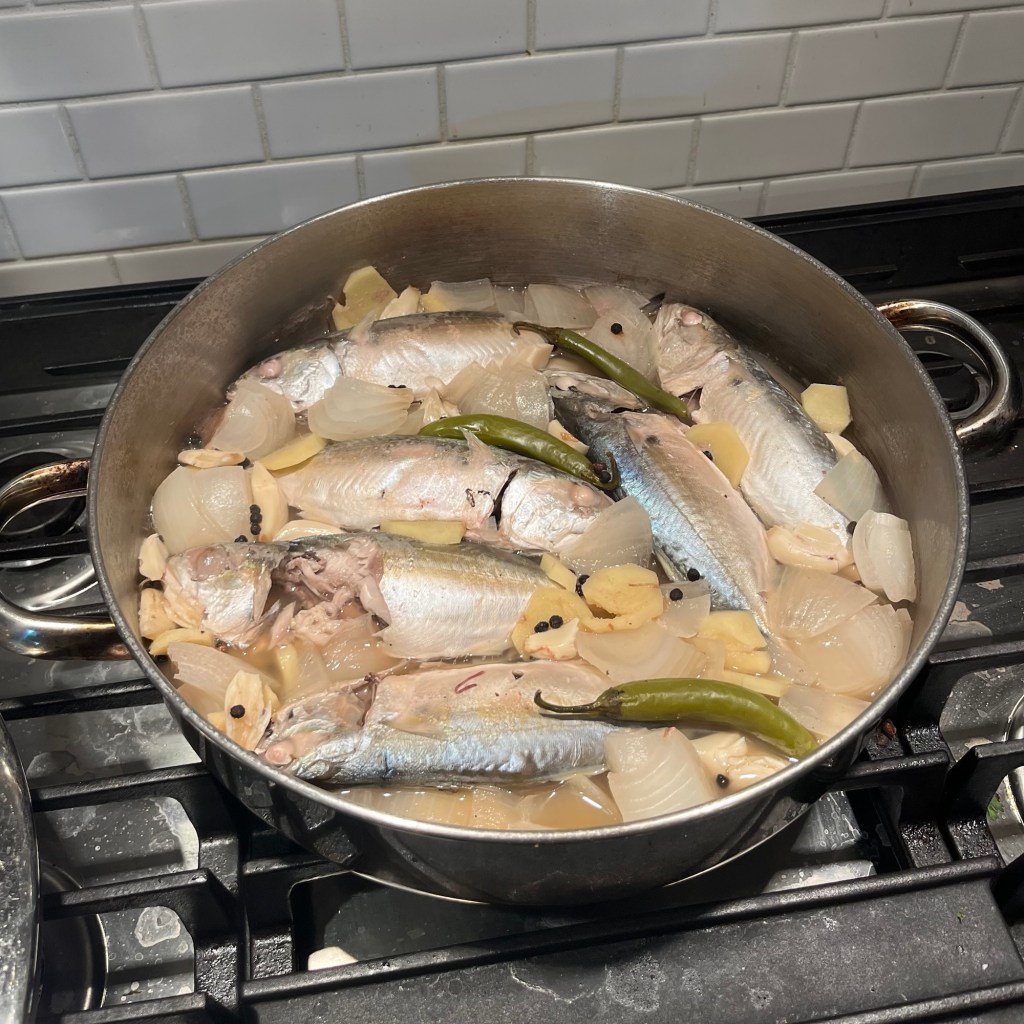
Eventually I went up to him and asked him for help. He didn’t have much in the way of English but he knew exactly what to do when I said “paksiw”. He led me to the center aisle and pointed, alumahan. Indian mackerel. They were on the small side – about the size of my palm – with bright silver scales and a yellow band down the side. Covering one hand with a bag, I gingerly collected enough to fill my largest pan. I drove home with a sack of raw fish riding shotgun.
I’ve done a lot of thinking about my heritage and what it means to be an “authentic” Filipino. On one hand I want to believe that doing stuff like this brings me closer to my culture, that cooking island food legitimizes me via merit or karma or something like that. On the other hand, that logically doesn’t make sense. I wouldn’t fault someone for not cooking native recipes. Hell, most people I know don’t cook at all, let alone the food of their ancestry. And anyways, I’m certainly “lacking” in other ways. I can’t speak tagalog, I’m not Catholic, I haven’t been to a Filipino party in years, etc. Making paksiw wouldn’t redeem me from this. So, what was the point? What was I really looking for? I figured I’d know after dinner.
As soon as I got home, I got to work. The good thing about this branch of cultural exploration is that I’m already a very capable chef. Fish might be foreign to me, but the kitchen certainly is not. I gave myself plenty of time and measured out all the ingredients. First, the water and vinegar. Pan, piping hot, liquid in, simmer. I set the fish aside in a shallow bowl while I cut the vegetables: sliced and crushed ginger, garlic, whole chili, chopped onion. Fish sauce, salt, msg. I carefully arranged the fish in the bubbling pan, and pushed the rest of the ingredients into the crevices. It was an artful exercise; the contrasting colors and shapes made me happy. While it simmered, I cleaned the kitchen and fell into deep thought.
When I was initially choosing the recipe, I noticed a lot of discourse in the comments: lively debate about the variety of chili, the merit of additional ingredients, the controversy of cooking oil. Everyone had their own recipe, but at the end of the day, they were all making the same thing; they were all making paksiw. Unless you were trying really hard to mess it up, there was no wrong way to do it, much in the same way that there’s no wrong way to be Filipino. Too on the nose? Sue me. Cooking an authentic Filipino dish doesn’t make me more Filipino, but it’s my way of claiming identity; that’s what matters at the end of the day. Maybe this is too ambiguous – the Rachel Dolezals of the world are champing at the bit here – but I’m happy with that for now.
The paksiw was ready in less than thirty minutes. When I took the lid off, the aroma wafted out and I was immediately transported into a memory, fuzzy around the edges. I’d smelled it before, I knew that for certain, but from where I couldn’t say. Was it from my lola’s place when we visited some 15 years ago? Some errant Filipino potluck? Wherever it came from, it seized me in that moment, you already know what you are, you already know what this is.
The fish held its form in the pan, but pulled apart into flakes with some gentle suggestion. The flavor was sour, savory, and light, but not lacking in body. For how simple the recipe was, it had a surprising amount of depth. I was worried that whole chilis wouldn’t express enough flavor, but the vinegar pulled out just the right amount. I ate one fish, then two. I saved the rest for my parents. I put my dish in the washer and nodded, drying my hands. This isn’t the last time we’re doing this. No, this is just the start. The remaining fish sat in the pan, shining in the sauce. I stared at the fish, and the fish stared back.
 Center of Gravity
Leave a comment